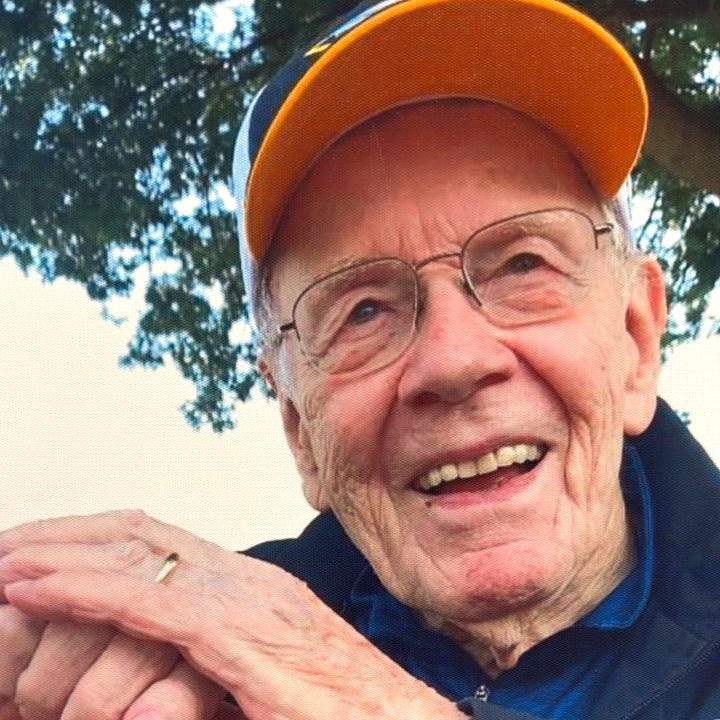
A Mighty (Humble) Man
(Written yesterday)

This afternoon, I was scrolling through my emails when I saw one that stopped me in my tracks. Today was the day. I canceled all other plans for the afternoon (and I had many). Fortunately, I had seen the email in time and in fact I had about fifteen minutes to organize myself and find the right place online to watch a memorial service for a ninety-seven-year-old man—one that I would have been very disappointed to miss. And yes, I’m going to tell you why.
When Walter and I were a young married couple aiming for the mission field, there were two older missionary couples (apart from our own parents) who really discipled us and inspired us and invested in us. The first of these was Bob and Carol Lee Blaschke.
The first year we were married, I was still a full-time college student in my senior year. Bob and Carol Lee had just arrived to be the very first missionaries in residence at what was then LeTourneau College. They had been missionaries in Benin, West Africa, for close to thirty years. Bob taught Bible and missions classes, and Carol Lee was the college nurse. Their future daughter-in-law, Charlene, was the only other English major on the campus, and we worked together in the English department. And through her, I met Bob and Carol Lee’s daughter Beti (now Elizabeth), who became a lifelong friend.
That first year of our married life, we saw more of Carol Lee than Bob, because we both had allergies, and she could get us allergy medicine for free. And it was during one of these visits for allergy meds that Carol Lee and I got to talking about our own hopes for missionary service, and she said, “You know—I’ve got a brochure here somewhere. This place sounds like it would be perfect for you.” And she rummaged around and produced a little brochure for a missionary training organization called Mission Ready. A couple of years later, after moving to Georgia, we would travel to Mission Ready and meet the other couple who became so central to our lives—Paul and Betty Lou Teasdale. So we have Bob and Carol Lee to thank for that.
They ended up staying on as missionaries in residence for four years, during which time we moved to Georgia for two years and then returned. Our new house (owned by the college) was just two doors down from Bob and Carol Lee, so we saw a lot of them. We had many deep and helpful conversations about missionary life and ministry.
At the end of the four years, they stayed in town (moved to a new house) and Bob began a new ministry. Their mission, SIM, was a pioneer in ministering to the children of missionaries—MKs. Bob was the first person to head up their department of MK Education and Ministry. He rented some office space in town, and as it happened, he needed a secretary, and asked if I’d be interested. Armed with an English degree and an empty bank account, of course I said yes.
The months that followed I sometimes think of as the equivalent of getting a master’s degree. Sometimes I felt a little superfluous and wondered why he needed a secretary at all. Now, looking back, I think he really valued my input because I was an MK who had gone to three different boarding schools, and also a couple of day schools, and in his new job he was dealing with all kinds of missionary families and their education choices. (More about that anon.)
I in turn received a master class in how to be humble, compassionate, and competent. Bob’s credentials were almost unbelievable to me. At 24, he went to West Africa and installed himself in a village amongst an unreached people group. They had no written language. He lived in a mud brick hut with no electricity and no running water. He had to learn French first, so he could then figure out how to learn the Boko language, which from what he told me sounds fiendishly difficult.
Once he had a grasp of the language, he had to figure out how to write it, so he could start creating primers with which he could teach people to read—all of which was a preliminary to translating the Bible into Boko and then planting churches and training up Boko church leaders. During this process he eventually met and married Carol Lee, and they had five children.
By the time they came to LeTourneau as missionaries in residence, they had achieved everything they’d set out to do. The Boko had their own Bible. They had their own church leadership and a network of thriving churches. This is why Bob was free to take on another ministry. To this day, he’s the only missionary I’ve ever met who went into an unreached people group, created a written language for them, translated the Bible, planted churches, trained church leadership—and then left them to carry on the good work. Wow.
So when I was working for him, he was very focused on MKs and their education. He went to a couple of big MK conferences and then had me organize and type up all his notes (very educational and thought provoking). We spent many hours discussing them.
And then, that summer, he inadvertently set me on the path that would lead me to homeschooling. We had talked about homeschooling at some length. We both deplored it. But he had to look into it because some newer missionary couples were refusing to send their kids to boarding school. It so happened that one of the “big” names in the early homeschooling movement was coming to do a two-day seminar right here in Longview. And Bob paid me to go in as a spy and try to figure out how these people thought so we could defend against it. I am not making that up.
So I went in literally as spy in enemy territory. I took copious notes—most of which were very snarky and critical. I thought I was so clever. However, the child training sessions were very interesting to me because I hoped to be a parent in the not-too-distant future. So I reported my findings back to Bob and there were many more hours of discussion. He was trying to figure out where to draw the line. Was it right for a mission organization to demand that every family make the same education choices? We both knew that boarding school is not a good choice for every child.
One thing he said to me has resonated with me in the decades since. He said, “You know, in my lifetime, in missions we have gone from believing that no sacrifice is too great in order to spread the gospel, to believing that now no sacrifice is acceptable.” I think about that often. Modern missions won’t accept you if you have health problems—even if you’re willing to live with them, and willing to risk not receiving the level of medical care you’d get in your sending country. Was it right for some of those pioneer missionaries to sacrifice their own families on the altar of their ministry? Would there have been a way to honor both objectives? These are the kinds of things we talked about for hours on end. I’m telling you, I would have done that job for free.
Eventually, I became pregnant with Lina and I had to stop working for Bob because I couldn’t stop throwing up. But we stayed close with him and Carol Lee. They moved to South Carolina, and not long afterward I flew there for the joyous occasion of Elizabeth’s wedding—and making her wedding cake. Before I left, a friend here said some very negative things when I mentioned that Elizabeth was marrying a Bolivian man. She believed that Hugo was just marrying Elizabeth because she was American and could get him a green card. I didn’t believe it for a minute, but her words troubled me.
When I got to South Carolina, I told Carol Lee what my friend had said. And she grabbed me by the shoulders and said, “Linda, you know that isn’t true. Don’t let anyone steal your joy.” What a gem she was.
When Lina was three and Flynn just two months old, we traveled east to go to candidate school for Africa Evangelical Fellowship in Boone, North Carolina. Children were not allowed unless they were nursing babies, so Bob and Carol Lee offered to keep Lina for the full two weeks, while we took little Flynn with us.
Boy, that was hard—leaving our three-year-old behind. But there was no one in this world I trusted more than those two. Lina had a wonderful time while we were gone. Carol Lee was so creative in thinking up fun activities for her. And when we returned, full of all the things we’d learned, we had Bob and Carol Lee as sounding boards and advisors to help us make sense of it all.
The very next year, I sheepishly signed up for the homeschool seminar I had previously mocked. I had a four-year-old who begged every day for me to teach her to read, and had recently learned that the adult illiteracy rate in our area was very high. I no longer trusted a public school to teach my child to read, but I was pretty sure I could do it. And I don’t believe this would have happened if I hadn’t worked for Bob and gone in as a spy a few years before! And yes—she was reading pretty well by her fifth birthday and is now about to graduate with a master’s degree in library science!
We didn’t see much of Bob and Carol Lee after that, what with living several hundred miles apart. Bob wrote a book about evangelizing animist societies, called Quest for Power. It is excellent. I’m thinking maybe I should reread it.
Carol Lee died of cancer in her sixties. I called her several times to see how she was doing during her illness. She was always cheerful and optimistic. She practiced what I would describe as radical optimism in every area of her life. If I had any difficulty, I knew I could talk it over with Carol Lee and she would find the bright side.
Then one day I called and Elizabeth answered. I asked her how her mom was doing and she said, “Great! She’s doing really well.” I thought that meant that her treatment was working. What Elizabeth didn’t add was that she was doing really well for someone who is dying of cancer. A few days later I called again, hoping to hear she had improved. Instead Charlene answered the phone and when I asked about Carol Lee, she said, “I think she’s going to meet Jesus very soon.” I felt as if all the air had been sucked out of my body. Carol Lee died three days later. I still miss her.
Bob eventually remarried, and we enjoyed reading his newsletters. Then he was widowed again, and spent the last few years of his life in South Carolina near some of his kids and grandkids. He died a few months ago, and today was his memorial service. Every one of his five children got up to speak a tribute to their dad. Also former coworkers, MKs, and four of his granddaughters.
The service lasted two hours—but it could have lasted much longer, if everyone who was blessed by Bob’s ministry could have been there. I think of the thousands of Boko believers in Benin who have Bob to thank for their faith. All the MKs who benefitted from his and Carol Lee’s ministry. And I know when he arrived in heaven, he was greeted by a vast host of people who went before him and eagerly awaited his arrival.
During the service today, I noticed that several family members and friends referred to Bob as an “ordinary” man who achieved great things. I don’t think he was ordinary at all, and not just because I looked up to him as a mentor. He was extraordinary in so many ways, and one of the things that made him extraordinary was the fact that he thought of himself as ordinary, despite everything that he’d accomplished. Always humble, always self-deprecating, always with that twinkle in his eye. And yet, as one of his granddaughters put it—he was a superhero. I’ll forever be thankful that God brought Bob and Carol Lee into our lives right when we needed them. And I’m sure I’m just one of hundreds who could say the same thing.